
Stages of Team Development
Group Behaviors & Facilitative Moves
Stages of Team Development (Tuckman, 1965; Zuiebeck, 2012) is a framework for assessing team characteristics that can support facilitators to determine appropriate interventions to reach their teams’ shared goals.
Teams in the “I” stage need attention to group safety and stability. Teams in the “We” stage are ready to take more collective responsibility for their work together. The “Task” stage is where deeper work and collaboration takes place – this is where experimentation and designing transformative interventions can happen.
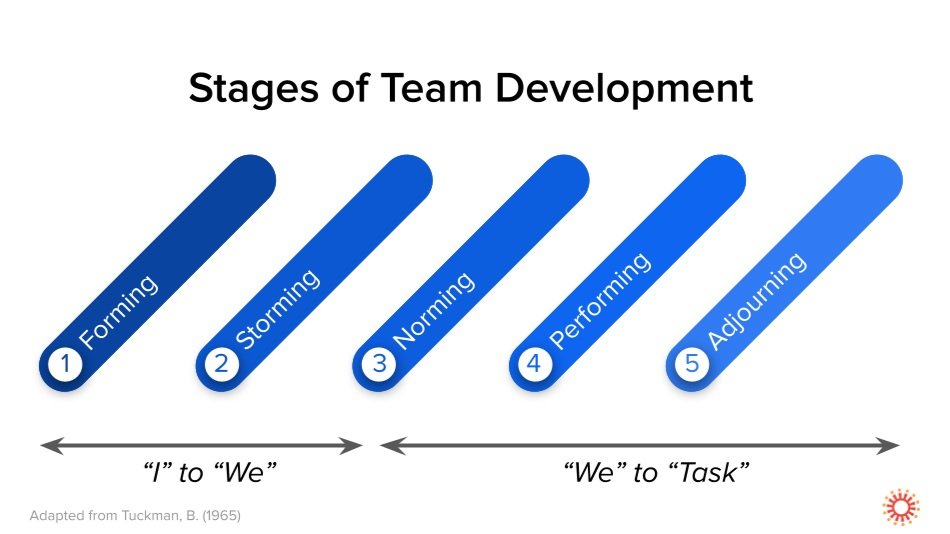
In each stage, there are different ways that oppression and systemic barriers can negatively impact progress toward shared goals. Leaders and team facilitators can identify and use structures that intentionally mitigate those barriers within their own team in order to create inclusive experiences for all group members, and ultimately for the communities they serve.
The charts below detail both Group Behaviors and Facilitative Moves (both technical and relational) across the stages. In reviewing these, leaders can assess the ways in which power imbalances and exclusionary dynamics might be showing up within their group. In addition, it is important to attend to both technical and practical needs, as well as the relational and cultural dynamics of the group.
Group Behaviors
-
Polite/watching others
Hesitant participation
Minimal trust, some suspicion
Looking for sense of belonging
Establishing individual identities
Lack of clarity about group goals
Complaints are common
Tentative commitment to group mission
-
People do not feel heard and a part of the decision making process
Confusion about roles
Resistant to structure
Lack of decision making
Lack of unity across difference
Minimal collaboration across difference
Frustration about individual vs. team responsibilities
“One-upmanship”
Vying for position and power
-
Effective decision making
Structures used to ensure balance of voices in decision making
Visible collaboration across difference
Shared commitment to group mission/goals
Increased appreciation and trust across difference
Group members begin to give and receive feedback productively
Shared agreements on how the group will navigate conflict
Shared understanding of roles and responsibilities
Information readily shared
-
Efficient and inclusive team operations and decision-making
Pride in equity-focused accomplishments
“We” vs. “I” orientation
Team members give and receive feedback effectively to improve process and outcomes
Team is learning and growth-focused
High trust and openness across difference
High appreciation and support across difference
Shared sense of team identity and cohesiveness
High confidence in the team
Facilitative Moves: Technical
-
Use a structured process to develop and agree on community agreements
Charter the team: clarify vision, purpose, short and long-term goals, procedural and meeting agreements, etc.
Structure process for regular written feedback on meetings (anonymous at first)
-
Adapt agendas and facilitation based on input from the group, communicating how and why changes are made
Review/ revise community agreements
Develop guidelines for giving and receiving feedback
Agree on how to hold each other accountable for agreements/goals
Decide on a process for resolving conflict among team members
Initial attempts to use protocols to structure work
Refine goals/strategies and theory of action for the year
Begin to assess progress toward goals
-
Review/ revise community agreements
Request and encourage direct, productive feedback to each other
Provide periodic team development opportunities (such as retreats, learning and social opportunities, team self-assessment of dynamics & needs)
More consistent and productive use of protocols
More rigorous analysis of progress and barriers to goals
Engage the team to determine revisions to strategies to achieve goals
-
Share leadership role (e.g. rotating facilitation)
Encourage flexible roles
Routine team development opportunities (such as retreats, learning and social opportunities, team self-assessment of dynamics & needs)
Strategic and effective use of protocols
Analyze successes
Facilitative Moves: Relational
-
Meet 1:1 with members to build relationships
Provide information and direction
Build shared understanding about roles and responsibilities
Help members get acquainted, share beliefs, perspectives and experiences across difference
Build trust and safety across difference, offer structures to process emotions and experiences
Be sensitive to member needs
Encourage risk taking
Actively engage and involve all members
Work with the group to develop a shared purpose; ensure it is grounded in equitable outcomes for the community
Begin to develop group goals in relation to historically underserved populations in the community
-
Meet 1:1 with members to understand and address needs
Provide necessary information, training, and resources based on needs
Acknowledge conflict when it occurs; if there are patterns of power, name them to find ways to shift the dynamics
Encourage differences of opinions, especially across difference
Directly support conflict resolution among individuals as needed
Acknowledge that different perspectives are helpful; celebrate different perspectives and use them to drive the work forward
Acknowledge the emotional impact of conflict; structure productive emotional release
Clarify / revise roles and responsibilities as needed
-
Check-in with members 1:1 as needed
Ensure effective information flow throughout the team
Support others to facilitate conflict resolution
Support others to facilitate meetings, use protocols, etc.
Structure personal reflection on work and progress toward goals; attend to differing emotions and perspectives based on identities
-
Encourage regular, open communication
Encourage individual and team ownership of conflict resolution
Acknowledge and celebrate shared leadership
Encourage regular, reflection on the work (strategies, goals and team dynamics)
Facilitative Tools
Technical
Relational
Learn More
References
Tuckman, B.W. (1965). “Developmental Sequence in Small Groups.” Psychological Bulletin.
Zuiebeck, S. (2012). Leadership Practices for Challenging Times. Principles, Skills and Processes that Work. Synectics, LLC.