
When Dr. Kim Carter became superintendent of Battle Creek Public Schools in 2017, she knew exactly what the district needed. Having experienced National Equity Project's transformative approach to leadership development at a previous organization, she immediately reached out to NEP to partner on what would become nearly a decade-long journey of systems change.
"It's really the focus on the heart sets and mindsets," Carter explains, "rather than those real specific strategies, but more so just really understanding who you are, and how you bring your lived experience into the work of change."
What began as professional development has evolved into a comprehensive partnership that has fundamentally shifted how Battle Creek approaches educational equity—from leadership practices to classroom design to student voice.
The Foundation: Building an Equity Imperative
In the partnership's early stages, Battle Creek leaders worked with NEP to create something that would become the touchstone for all district decisions: their equity imperative. During a multi-day retreat with over 50 district leaders, NEP Director of Strategic Consultation, Hugh Vasquez, and his team facilitated the development of this foundational statement.
"They didn't have an equity imperative until we started working with them," Vasquez recalls. "We were in the room, creating it with them—from the inception of the statement to the completed statement."
The statement they created reads:
Because we see the value in and respect all cultures in our communities, we will disrupt the inequities that exist within our system. Because we choose to acknowledge the individuality of our students and who they are, we will acknowledge our own bias and privilege. Because we believe in the infinite possibilities of our students and their future, we will transform inequitable practices.
Battle Creek’s equity imperative became a living filter through which they’ve evaluated every major decision, every new initiative, every system design. Years later, it remains central to how the district operates.
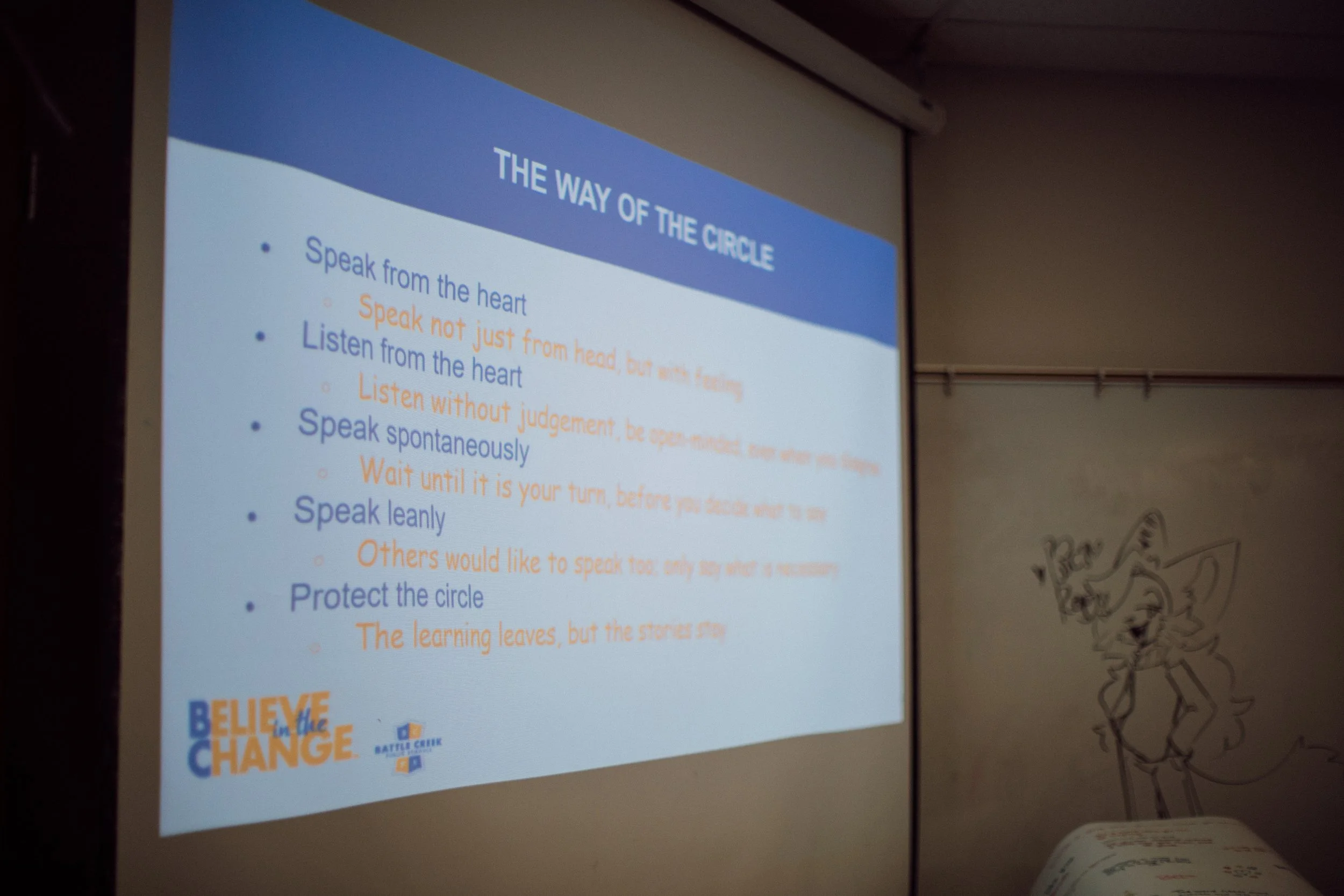
"They've kept it in front of them," says Vasquez. "In the early days, they would put a slide up at every meeting, and they'd have people read it. But they began to evolve—not just to read it, not just to orient new people to it, but to hold it up as a lens to see if they were moving towards that."
Creating Space for Honest Conversation
For Dr. Anita Harvey, who was a principal when the partnership began and now serves as Deputy Superintendent, the early work with NEP created something she hadn't experienced before in her educational career: permission to be honest.
"I'll never forget it because we were talking about bias and stereotypes, and it was very raw to say the least," Harvey remembers. "I loved every minute of it because it was a space that gave us permission to say the things that we thought but did not feel comfortable engaging with on a day-to-day basis."
That permission evolved into a practice. Harvey describes how NEP's Leading for Equity Framework became her leadership mantra. "I operate on see, engage, act,” she says with pride. “That is my mantra as a leader because that was so transformational in getting things named. Understanding why things are existing the way that they are in order to inform your action."
From Reactive to Responsive
One of the partnership's most significant impacts has been helping Battle Creek leaders distinguish between reactive problem-solving and responsive systems design.
"What I love to this day about NEP is they're able to lift you back up on the balcony so that you can truly see the system," says Carter. "Because when you're in the day-to-day operations of what's happening and you're trying to react, they make you pause, stop, exhale, and see the system so that you can actually impact and affect change."
But this shift from reaction to reflection wasn't always easy. "They had too many things on the plate,” Vasquez says, describing the district's early approach as well-intentioned but overwhelming. “All their ideas were good, but there's no way a system can actually change and implement all those things."
Through weekly strategy sessions—which continued for nearly seven years—NEP helped Battle Creek leaders become more sophisticated in their approach to systems change. "They can articulate the change that they're after, what they think is going to make that change happen, how they'll know if it's being effective, and what their next steps are," Vasquez notes. "They can actually answer those questions now, whereas in the early stages, they just had strategies."
Centering Student Voice
Perhaps nowhere is Battle Creek's evolution more visible than in how the district now centers student voice. They’ve established a student advisory council across secondary schools and implemented a new strategic plan with creating a positive school experience at its center.
This year, the district began surveying students three times annually on belonging, safety, and being heard. "We're getting a pulse on that data so that we can go back to schools and say, ‘we had a problem here because kids don't feel like they belong,’" Harvey explains. "We can not wait until the end of the year to have benchmark data that tells us whether we are doing something well or we need to change course."
They took an even bolder step recently by allowing students to lead their staff opening day. In a fireside chat, students from sixth through twelfth grade—including those experiencing both academic success and challenges—shared their experiences directly with teachers.
"They would say things like, 'we know our teachers work really hard, but sometimes they're working too hard. All you have to do is ask me how my day is so that I can get started with you in a different way,'" Carter recalls. "They were just telling them the truth about their experience."
The Power of Partnership
With all the progress they’ve made, Carter emphasizes that Battle Creek's transformation isn't happening in isolation. The district engages over 100 community partners and convenes more than 30 community leaders monthly to address student needs collectively.
"NEP gives you the language to use with partners to help them take ownership of the students," Carter says. "We have shared ownership of the children that Battle Creek Public Schools serve, and it hasn't been left up to just the school district to ensure that kids are successful."
Sustaining the Work
Both Carter and Harvey are clear-eyed about the ongoing nature of equity work. "The need for equity work doesn't go away," Carter reflects. "It's not something that you just do and you're done. We have to think about how we embed this into our daily actions, not just monthly professional development, but lived out daily and intentionally and explicitly."
For Harvey, the partnership has filled her leadership toolbox with approaches she continues to use. From the rebel leadership framework to the six-circle model that helps leaders plan both technical and adaptive work, these tools support Battle Creek's sustained commitment to their equity imperative.
Nearly a decade into their partnership, Battle Creek Public Schools shows us what's possible when a district commits to equity as a daily practice rather than a one-time initiative. Their equity imperative remains not just a statement on a slide, but a living framework that guides every decision, every system design, and every conversation—always in service of ensuring every student has what they need to thrive.

National Equity Project has partnered with Battle Creek Public Schools since 2017, supporting system-wide equity design focused on universal academic proficiency, targeted support for students farthest from educational success, and equitable classroom environments.
Learn more about how the National Equity Project can support your work to create thriving, youth-centered learning environments.
